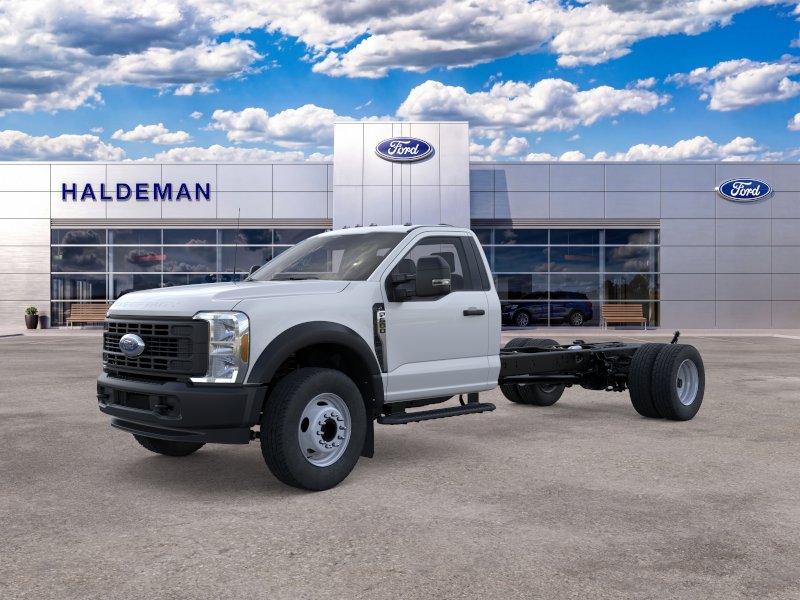
New Ford Super Duty F-600 DRW for Sale Near Philadelphia, PA
Frequently Asked Questions about New Ford Super Duty F-600 DRW Philadelphia, PA
What do I need to check about drivers before buying an F-600?
This is the question that most often catches out a first time buyer at this weight. What gets asked of the person behind the wheel can shift with how the truck ends up built, so treat it as part of the specification rather than an afterthought. Some of those answers come from outside our building, and we will tell you where to look.
Should I specify a new truck to match the ones I already run?
Where you can, it repays itself quietly for years. Every difference between two trucks becomes a second part on the shelf and a second thing a driver has to remember at six in the morning. Send us what is already in your yard and we will build from that.
How do I know whether I need an F-600 rather than the rung below?
Frequency, not ceiling. Almost everybody who ends up here got here by watching a smaller truck work too hard for too long, rather than by reading a comparison. If you are still guessing, describe a heavy week and we will say where it lands.
What does a maintenance program look like for a truck this size?
In practice it is a calendar more than a document. Somebody decides in advance when the truck comes off the road, and that date wins over almost everything short of an emergency. Businesses that hold that line spend less and lose fewer days than those that do not.
Why does downtime matter so much on this class of truck?
Because the invoice is the small part. A truck that stops has usually promised somebody a delivery window, and around here those windows are tight enough that one failure travels. That is the cost worth designing against.
Have Additional Questions?
Already running heavy trucks? Tell us the configuration and we will spec the new one to match rather than to differ.
We can set up a maintenance program around your operating pattern before the truck goes into service.
Send us the work and the timeline and we will tell you what is realistic to source.
The Questions an Operations Manager Brings
Somebody buying an F-600 for a business asks a different set of questions than somebody buying a truck for themselves. Less about how it drives, more about who can legally operate it, how it fits the fleet already running, and what happens the week it needs work.
Driver licensing is the one that catches people out at this end of the range. Depending on how the truck is configured and what it is doing, the requirements for whoever sits in it may differ from the rest of your fleet, and that is worth confirming while you are still choosing rather than once the truck is delivered.
- Licensing requirements confirmed for whoever will drive it
- How the truck slots into the fleet you already run
- Service arrangements agreed before the truck enters service
We would rather raise this early than have you discover it during onboarding. Haldeman Ford can point you at the right questions even where the answers are not ours to give.
The truck is rarely the complicated part of an F-600 purchase. Everything around it is where the planning goes.
Specifying the Second Truck to Match the First
If this is not your first heavy truck, the most valuable thing you can do is specify it to match what you already run. Identical or near identical trucks share parts, share training, and let a driver move between them without relearning anything.
Fleets that drift, buying whatever was available each time, end up carrying more spares and more training overhead than they realize. It is a slow cost and it is almost entirely avoidable at the point of purchase.
- Configurations kept consistent with the trucks already in service
- Shared parts and shared training across the fleet
- Drivers able to move between units without relearning them
Tell us what you already run and we will spec against it rather than starting from a blank sheet. That is a genuinely different exercise from shopping for a single truck.
Consistency is the cheapest thing a growing fleet can buy. It costs nothing at purchase and saves continuously afterward.
What Pushes a Business to the Heaviest Rung
The F-600 sits at the heavy end of the Super Duty range, and businesses arrive here for a fairly narrow set of reasons. Either the loads sit at the edge of what a lighter chassis handles every day, or the work involves a body and equipment needing a heavier foundation than an F-550 gives them.
Nobody buys one for headroom on the off chance. Businesses that land here have usually run the lighter option first and found it working harder than they wanted it to.
- Loads that sit at the edge of a lighter chassis every day
- Bodies and equipment needing a heavier foundation underneath
- A step taken after the lighter option proved marginal
If you are choosing between this and the rung below, the deciding question is how often you are at the limit rather than how high the limit is. Daily is a very different answer from occasionally.
Running a truck at its ceiling every day is expensive in ways that never appear on the purchase order. That is the case for the heavier chassis.
A Maintenance Program Instead of a Repair Bill
At this end of the range, maintenance stops being something that happens when a warning light comes on. A truck this size failing unexpectedly does not only cost a repair, it costs whatever the truck was supposed to be doing that day and probably the next one.
Fleets that run well treat servicing as a scheduled operational item rather than a reaction. Intervals set against hours and load rather than mileage alone, wear items replaced on a plan, and the whole history held in one place so nothing gets diagnosed twice.
- Intervals set against how hard the truck works, not mileage alone
- Planned replacement of wear items ahead of any failure
- A single service history so problems are not rediagnosed
Our service department can build a program around your operating pattern rather than a generic schedule. For a business running several trucks, that predictability is worth more than the individual invoices.
Unplanned downtime is the largest line item in a small fleet and the one nobody budgets for. A program is how you turn it into something you can forecast.
Distribution Work Across the Philadelphia Metro
The Philadelphia metro carries a great deal of distribution and construction activity, and much of it depends on trucks in this weight class moving reliably. Warehousing, materials supply, equipment servicing, and the contractors keeping all of it running.
Working across this region adds its own pressure. Runs frequently start or finish somewhere dense, delivery windows are tight, and a truck out of service on a Tuesday morning creates problems that reach several businesses down the chain.
- Runs that begin or finish in congested parts of the region
- Delivery windows that leave little room for a delay
- Downtime that reaches beyond your own operation
Businesses in the Philadelphia area running these trucks tend to value predictability above nearly everything else. That shapes what we recommend and how we set up the service side of it.
A heavy truck that always starts is worth more to an operation than one that is occasionally faster. Everything here is arranged around that.
Tell Haldeman Ford what you already run and what the new truck has to do, and we will spec it to fit the fleet rather than to stand apart from it.